SVETOSS Difficult Case - Femoral Fracture Revision Major
Breed: dog,age: 1 year and 7 months old,gender: female neutered,weight: 6.8 Kg.
Every case of
fracture revision is a long story.
It started
with a simple mid-femoral fracture. It was surgically repaired. Postoperative
x-rays showed the bone plate was the right length and the screws were well
distributed, but the plate seemed small. A week after discharge from the
hospital the pet owner took the dog for a walk in the park and had an accident.
The pet owner
brought the dog back to the hospital for a second surgical repair with double
plates. Under normal circumstances, healing should have been no problem.
However, unfortunately, an infection and loosening of the implant occurred. The
fracture did not heal.
The pet owner brought the dog to our hospital for surgical repair. We removed all of the previous implants and some of the implants were sent for bacterial culture and drug sensitivity testing. The fracture was fixed using a Kirschner wire with a bone plate (one size larger)by using bridge technique. Considering that fracture healing was definitely delayed, autogenous cancellous bone graft was used to stimulate bone growth and sensitive antibiotics were administered for 6 weeks. At the six-month postoperative review, the infection was not controlled and the fracture did not heal, although the implant had not yet failed. After communication with the pet owner, the implant was removed, sent for bacterial culture and drug sensitivity testing, the wound was flushed, and then the wound was closed. Use sensitive antibiotics to control infection. Surgery is performed at another time after the infection is controlled.
Preoperative X-rays:
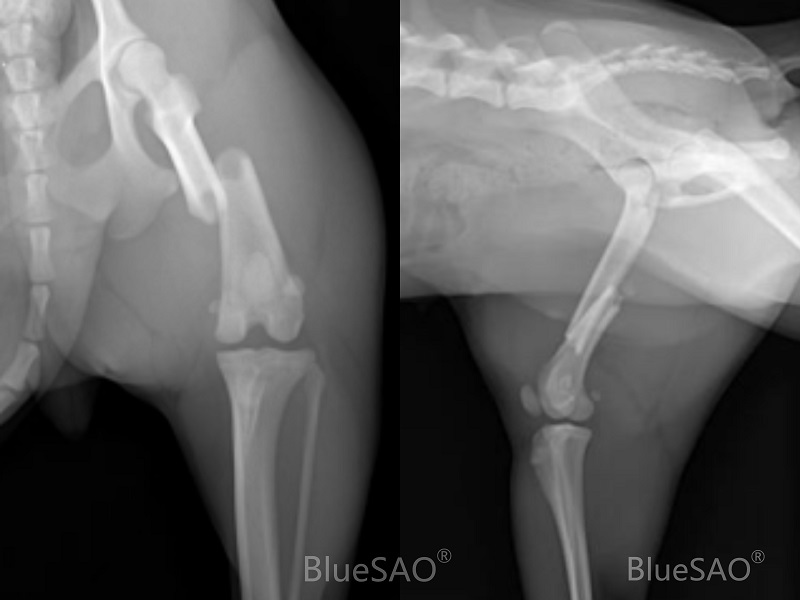
Log in to view the full medical record
Please Login to View AllOrthopedic Instruments We Use BlueSAO